
11/04/2026
Administrator
Picture this. January. Sapporo, Japan. It's freezing. There are 38,000 people crammed into a dome to watch three-person squads play Apex Legends. Not FIFA. Not League of Legends. Apex. A battle royale. The same genre people were calling a gimmick six years ago.
That moment kind of sums up where we are in 2026. Battle royale esports didn't just survive the "it's too random to be competitive" criticism — it outgrew it. The biggest games in the genre are now pulling real money, real crowds, and real organizational investment. And the tournaments this year? Some of the most stacked the genre's ever seen.
So let's actually talk about what's happening.
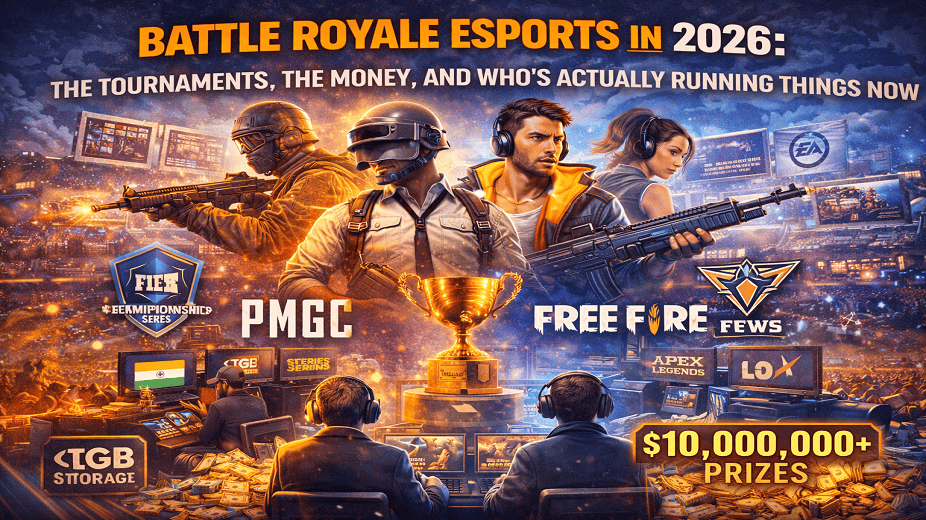
The Esports World Cup in Riyadh is now the unmovable center of the competitive gaming calendar, and love it or hate it, you have to acknowledge what it's done for prize money across the board. This year's edition runs from July 6 all the way to August 23 — nearly seven weeks — and the total prize pool is $75 million across 24 game titles. Up from $71.5 million last year. Saudi Arabia's Public Investment Fund keeps pumping money in, and the result is that esports organizations are now building entire rosters and competitive strategies around this one event.
Five battle royale titles have slots at EWC 2026. Five. Apex Legends, Fortnite, PUBG, Call of Duty: Warzone, and Free Fire. That's not a coincidence — battle royale is broadcast-friendly in ways that matter to an event trying to reach mainstream audiences. One squad. One map. Last team standing. Even your dad can follow it after about ten minutes.
The $30 million Club Championship that runs alongside the individual game tournaments is what really changes the economics though. Organizations like Team Falcons, NRG, and others aren't just sending one roster to Riyadh. They're sending multiple teams across multiple titles, and every placement contributes to their overall club standing. So if your Apex squad finishes top five AND your Warzone duo makes a deep run, the cumulative points stack. It's turned the EWC into something that resembles a proper sporting league more than a tournament.
Okay, honest opinion — ALGS might be the best-run competitive circuit in the battle royale genre. The format is tight, the regional structure actually makes sense, and the production quality at LAN events is up there with anything else in esports.
Year 6 launched in January with a $7 million annual prize pool. That's a million more than last year, which sounds like a modest bump until you remember this is a sustained, year-round commitment from EA and Respawn — not a one-time marketing spike. The structure splits across three global LAN events: Split 1 Playoffs at the EWC in Riyadh this July, Split 2 Playoffs in Las Vegas in October, and the ALGS Championship back in Sapporo in January 2027.
The Championship that kicked off the year in January — technically Year 5's finale — was something. 38,000 attendees. Sold-out finals day. A $2 million prize pool distributed across 40 teams. Team Oblivion won, with Blinkzr taking MVP. If you don't know Blinkzr — Miguel Quiles, Canadian pro — his story is one of those journeys through multiple orgs, some near-misses, the kind of thing that makes a championship hit differently. He didn't just show up and win. He'd been building to it.
Pro League Season 1 kicked off April 4th. 120 teams across four regions — Americas, EMEA, APAC North, APAC South — competing in a triple round-robin format for Championship Points. The $500,000 regional prize split sounds small compared to the headline numbers, but this is where careers are actually made. The kids grinding Pro League matches online every weekend are the ones who show up at Sapporo two years later and upset a team from an org worth $100 million.
Japan is also genuinely worth talking about in this context. The Apex fanbase there has grown into something that doesn't really have a Western equivalent. Peak viewership from Japanese content creators during ALGS Championship weekends consistently rivals the official broadcast numbers. Shibuya HAL alone can pull hundreds of thousands of viewers watching him react to Apex esports. That's the kind of organic ecosystem that's really hard to manufacture.
In 2025, Fortnite wasn't at the Esports World Cup. The EWC Foundation's CEO said the game didn't have a competitive ecosystem strong enough for the event. Which is a thing you don't often say about one of the most-played games on the planet, but there it was. Fortnite's FNCS had been chugging along, but it wasn't capturing the broader esports audience the way the old World Cup did back in 2019.
So Epic restructured. The Reload Elite Series is their answer — a six-month competitive circuit built specifically around Fortnite Reload mode, culminating in a $1 million LAN championship at EWC in Riyadh this August. Total series prize pool is $2.5 million, with $1.5 million distributed across four online qualifiers from January through June.
The decision to use Reload instead of standard Battle Royale is the interesting one. In Reload, as long as one teammate is alive, eliminated players can respawn. That means teams have a reason to fight rather than spend the first 15 minutes of a game hiding in a bush waiting for the circle to close. Matches are faster, messier, more aggressive — and just more entertaining to watch. For a broadcast setting, that's the difference between someone flipping the channel and someone staying up until 2am to watch one more game.
Competitive reactions have been mixed though. Some established pros feel Reload's hitscan weapons give controller players an unfair edge over mouse-and-keyboard. Others just don't like that the format changes what skill actually looks like in competition. And the eligibility requirements — you need Elite rank in Reload Ranked, account level 350 or higher, and at least 14 tournaments in the past 180 days — have rubbed some people the wrong way. The argument is that you're locking out newer talent who might genuinely be good enough but don't have the account history.
Epic's counter-argument is basically: we need a credible competition, not an open one, and smurfing has been a real problem. They're not wrong. But it does mean the Reload Elite Series is a fairly closed shop for now.
Still — 40 duos at a live LAN in Riyadh competing for a million dollars. That's a real event. And Fortnite returning to EWC visibility matters for the game's long-term health in the competitive space. Epic needs the next generation of players to see Fortnite as a serious esport, not just a thing their older siblings played.
Here's the thing about PUBG esports in 2026: it's probably in a stronger position than it's been in years, but it's also in the middle of a genuinely divisive internal fight.
KRAFTON announced a major overhaul for the 2026 competitive season. Twelve Global Series tournaments across the year. The return of the Nations Cup in June. Expanded calendar, increased prize pools. All good news. And then — the switch from first-person perspective to third-person perspective for official tournaments.
FPP was always the "competitive pure" format. No peeking around corners with your camera while keeping your character body hidden. No third-person camera giving you information advantages. Just you, your crosshair, and whatever's in front of you. A lot of the competitive community genuinely feels like FPP is what separates PUBG from a chaotic pub game, and switching to TPP feels like chasing a bigger casual audience at the expense of the game's competitive identity.
KRAFTON's defense is that they ran extensive testing through the PUBG Players Tour, held multiple meetings with teams and players, and believe TPP creates better spectator experiences. The logic isn't crazy — TPP gameplay shows more of the environment, makes positional play more visible to viewers, and matches how most casual PUBG players actually experience the game. If you want new fans to understand what they're watching, TPP probably is the easier onboarding.
Whether it works is something we'll know by the end of the year. The skeptics might be right. Or KRAFTON might pull in a whole new audience. We're genuinely in "wait and see" territory.
At the EWC, PUBG gets its tournament slot in late July, which gives the reworked format a massive platform. If it looks good on that stage, the criticism might quiet down. If it looks like a mess, expect a very loud off-season debate.
Western esports coverage — including a lot of what you'll read on big sites — has a blind spot the size of Southeast Asia. Free Fire is a genuinely enormous competitive title. Enormous. In Indonesia, Brazil, India, Thailand, Vietnam, the Free Fire World Series draws viewership numbers that would embarrass a lot of more "prestigious" PC esports events. It's a mobile battle royale with comparatively low hardware requirements, which means it reaches players in markets where a $1,500 gaming PC isn't remotely accessible. That's not a limitation — that's a feature. Those are the next billion esports fans.
Free Fire has its slot at EWC running July 15-18. The cumulative prize money across the global Free Fire competitive ecosystem is genuinely competitive with what you'd see in any other title. It just doesn't get covered in the same breath as Apex or Fortnite because it doesn't have the same audience in North America and Western Europe.
PUBG Mobile sits in a similar position. Over $113 million in total historical prize money across its esports history according to Esports Charts data. Let that number sit for a second. Teams from China, Southeast Asia, and the Middle East dominate. The PUBG Mobile Global Championship is a massive event that most Western fans couldn't name a participant of.
Call of Duty: Warzone has its EWC slot at the end of July, running through August 1. Warzone's competitive scene has had a chaotic few years — the game changed significantly with each new installment, and the anti-cheat situation has been a persistent headache. But having a structured EWC slot alongside a more organized circuit gives it stability it didn't really have before.
Prize pools don't just appear. Someone writes a check. And in 2026, the story of where battle royale prize money comes from is actually pretty interesting.
The EWC money is Saudi government money, routed through the Public Investment Fund. This generates some complicated feelings. The Saudi government's human rights record is real, and a lot of esports fans have strong opinions about the ethics of it. What's also real is that this money has created career-sustaining opportunities for hundreds of professional players who otherwise wouldn't have them. Both things are true and people are going to disagree about how to weigh them. That's a legitimate ongoing conversation, not one with an easy answer.
EA's investment in ALGS — growing the prize pool year over year, investing in LAN events in Japan, building out the regional Pro League structure — is publisher-funded competitive belief. The ALGS viewership numbers earned it: 60% year-over-year growth leading into the 2025 Championship, with peaks over 2 million concurrent viewers. That's the kind of trajectory that justifies increased spend.
Epic's $2.5 million Reload Elite Series is more strategic than philanthropic. Fortnite's absence from EWC 2025 was a PR problem. Coming back with a brand new format and a signed multi-year partnership is a statement — we're taking this seriously, we're not just here to throw money at it, we've actually thought about what competitive Fortnite should look like.
The broader shift in esports business — away from crowdfunded prize pools and toward publisher-sustained circuits — is probably healthier long term. The Dota 2 International used to get to $30+ million on fan-purchased battle passes. That number has dropped dramatically in recent years. But the tradeoff is consistency. A $7 million ALGS year is more valuable to players than a $4 million ALGS year that might disappear next season.
The sold-out arena in Sapporo in January. That's still the image that sticks. Thirty-eight thousand people in a city in northern Japan, in the middle of winter, watching Apex Legends. That didn't happen because of Saudi money or publisher investment or a well-structured circuit. It happened because people genuinely care about this game, these players, these stories.
Esports works when the games are good and the players are compelling and the stakes feel real. Battle royale, for all its randomness and chaos and occasional controversy, delivers all three. The randomness is part of it — it's why a team can dominate a tournament and still not win, and why an underdog can catch lightning in a bottle on the right day. It's frustrating. It's also why people can't stop watching.
2026 is not a moment of arrival for battle royale esports. It's just further down a road that's been building for a while. But if you'd told someone in 2018 that Apex Legends would sell out a 38,000-seat arena in Japan, or that Fortnite would be back at the EWC with a new format after being told it wasn't competitive enough, or that PUBG would be running 12 global tournaments a year while changing its core competitive ruleset — they'd have found all of that very hard to believe.
And yet. Here we are.
Figures and tournament information based on data available as of April 2026.
 Arcade
 Action
 Adventure
 Shooting
 Girl
Girl Puzzle
 Sport
Sport Horror
 Board
Board