

26/03/2026
Administrator
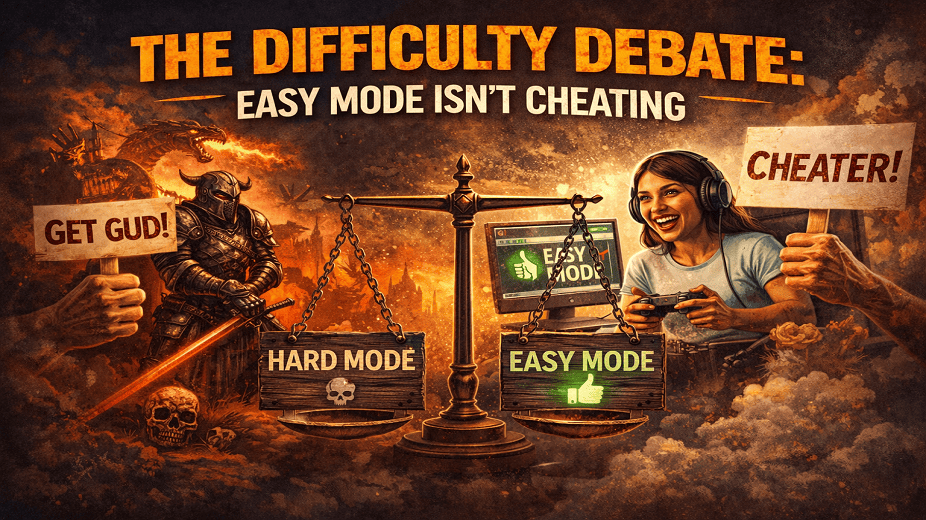
The Difficulty Debate: Easy Mode Isn't Cheating
I still remember booting up God of War on PS4 for the first time and getting absolutely wrecked in the opening hours. My thumbs hurt, I was yelling at the screen, and after the tenth death to the same troll I almost quit. Then I saw the option to drop the difficulty. I hesitated — felt like a coward for even looking — but I switched it down. Suddenly I could actually enjoy the story, the world, Kratos and Atreus bonding without every fight feeling like a full-time job. I finished the game, loved it, and never once felt like I’d “cheated.”
Yet online you’d think I’d committed some cardinal sin. Comments calling easy mode players “casuals,” “tourists,” or worse. The debate flares up every time a tough game drops — Sekiro, Elden Ring, Sifu, you name it. Some folks act like adding an easy mode would burn the entire industry to the ground. Here’s the thing most people don’t realize: easy mode (or any lowered difficulty) isn’t cheating, isn’t ruining the game for others, and doesn’t make your accomplishment worthless. It’s just a tool. And in 2026, with better accessibility options popping up everywhere, it’s time we stopped treating it like a dirty secret.
The loudest voices against easy modes usually boil down to a few arguments: it waters down the intended experience, it removes the sense of achievement, or “git gud.” I get where some of it comes from. When you spend dozens of hours mastering a boss pattern in a FromSoftware game, that victory feels earned in a way few other things do. The struggle becomes part of the story you tell yourself. Adding an easy button can feel like it cheapens that for everyone.
But here’s my take after years of playing both sides: your personal struggle isn’t diminished because someone else played on easy. Their completion doesn’t erase yours. It’s not a zero-sum game. The achievement is personal. If beating Malenia on NG+7 with no summons makes you feel like a god, great — that feeling is still yours whether or not some disabled player or busy parent beat her on story mode.
I’ve seen the mockery firsthand. Old games used to straight-up shame you for picking easy. Some still do in funny (or not-so-funny) ways — special endings, sarcastic voice lines, or locked achievements. It’s like the game itself is calling you a baby for wanting to enjoy the story without a migraine. That attitude stuck around in the community. People act like difficulty is a moral test instead of a design choice.
Most people don’t realize how many players quietly use easier settings or accessibility tweaks without ever admitting it. Surveys and accessibility reports show that a huge chunk of gamers — including plenty who consider themselves “hardcore” — adjust difficulty at some point. One big reason? Life gets in the way. You’re not less of a gamer because you have a job, kids, chronic pain, or just don’t want to spend 40 hours on one boss.
Let’s get real: difficulty and accessibility aren’t exactly the same thing, but they overlap a lot. For some players, “easy mode” isn’t about being lazy — it’s about being able to play at all.
Think about it. Someone with arthritis or limited hand mobility might struggle with precise inputs no matter how much they practice. A player with ADHD might find constant focus on patterns exhausting. Vision issues, hearing problems, motor disabilities — the list goes on. Studies and player interviews (like those from Access-Ability and academic papers on disabled gamers) show that difficulty options help a ton of people experience games they’d otherwise have to skip.
I know a friend with repetitive strain injury who loves action games but can’t handle long combos on higher difficulties. He drops to easy or uses assists and still geeks out over the story and world-building. Is he cheating? No. He’s adapting the game to his body so he can enjoy it. Another buddy recovering from a concussion played The Last of Us Part II on lower difficulty because bright flashes and quick reactions triggered headaches. He still cried at the ending and felt the emotional weight.
Recent accessibility recaps from 2025 highlight games doing this right with granular options: separate sliders for combat difficulty, puzzle difficulty, enemy health, player damage, auto-parry, etc. Titles like Prince of Persia: The Lost Crown (mobile version) and various PS-published games added customizable tweaks that go way beyond a simple “easy/normal/hard” toggle. That’s smarter design. It lets players tune the friction to what fits them without breaking the core loop.
Even big studios are shifting. More games now include invincibility modes, rewind features, or story-focused assists. The push isn’t “make everything brain-dead easy.” It’s “give players agency over their experience.” Because forcing everyone onto the same difficulty curve leaves a lot of people out — and the industry is finally noticing that excluding players means losing money and goodwill.
I’ve played on easy and I’ve played on hard. Both have their place.
Back when Dark Souls first clicked for me, I was stubborn. Died hundreds of times to Ornstein and Smough. The eventual win felt incredible. That rush is real. But I also remember trying Sekiro and hitting a wall so hard I almost dropped it entirely. The posture system and deflection timing just weren’t clicking with my reflexes that month. I put it down for a year. Later I came back, got better, and beat it on the intended difficulty. Good for me. But I know plenty of people who never came back — and that’s a shame, because the world, music, and bosses are fantastic.
On the flip side, I played God of War Ragnarök mostly on give-me-story difficulty because I wanted the father-son narrative without every encounter turning into a sweaty palm situation. I still learned the combat, upgraded gear, and felt satisfied when I pulled off cool moves. The story hit harder because I wasn’t raging through fights. Was the experience “lesser”? Not to me. I got what I wanted from the game.
Another time I watched my nephew — a kid with motor delays — try a platformer. Default difficulty frustrated him to tears because precise jumps were physically hard. We turned on assists and he beamed the whole way through, feeling like a hero. That joy mattered more than any purity test about “real” platforming.
Here’s what gets lost in the shouting: different players want different things from the same game. Some crave the brutal challenge as the main draw. Others want the story, exploration, or power fantasy. Easy mode lets both groups coexist without one ruining it for the other.
Developers sometimes say difficulty is core to their vision. Fair enough for some games. Dark Souls became iconic partly because of its reputation. Removing that entirely might change the cultural footprint. But optional modes don’t remove the hard path — they just add a parallel one.
Yoko Taro and other creators have talked about intended experiences, and I respect that. Yet many games already have hidden difficulty adjustments or ways to make things easier through exploration and preparation. Elden Ring lets you overlevel, summon spirits, or use cheese strategies. That’s basically player-created easy mode. Why shame someone for using an official slider instead?
Plenty of acclaimed games added or improved difficulty options post-launch or in sequels without ruining their legacy. Celeste has assist modes that let you skip tough sections or slow time. Hades has a system that gradually eases things if you’re struggling. God of War (2018) lets you change difficulty mid-game. None of these are remembered as “ruined” titles.
The truth is, most players who pick easy aren’t doing it to speedrun the credits. They want to see the content. They want the power fantasy, the beautiful worlds, the characters. Gatekeeping that behind hundreds of frustrating deaths just keeps the audience smaller.
Some games mock easy mode players with special dialogue or bad endings. That’s dated and kinda mean-spirited now. In 2026 it feels especially out of touch when accessibility is finally getting mainstream attention.
It’s not always turning enemies into wet paper towels. Good modern implementations are nuanced:
These options expand who can play without fundamentally altering the game for everyone else. Your hard mode run still exists. The boss design, level layout, and core mechanics don’t vanish.
I’ve switched difficulties mid-game more times than I can count. Started on normal, got stuck, dropped it for a section, then bumped it back up when I felt confident. No shame. The game didn’t judge me. Only the internet does.
Gaming has grown massive. Billions of players worldwide with different skills, schedules, abilities, and goals. Pretending every title should only cater to the hardcore minority ignores reality.
Accessibility features benefit everyone eventually. Older gamers, tired parents, people recovering from injury, casual fans who just want a chill evening — they all win when options exist. Even skilled players sometimes use assists for comfort or experimentation.
The industry is slowly catching up. 2025 saw more granular customization in big releases. Predictions for 2026 talk about even broader accessibility pushes. That’s good. It doesn’t mean every game becomes a walking simulator. It means more people get to experience the magic.
If a game’s entire identity is “brutally hard and that’s the point,” fine — make that clear upfront. But most games aren’t purely about difficulty. They’re about worlds, stories, mechanics, and fun. Easy mode protects the fun for more people.
I love challenging games. The rush of overcoming something tough is special. But I’ve also walked away from too many titles because the barrier was too high for where I was at in life or with my skills that day. That sucks. Easy mode (or better, customizable difficulty) keeps the door open.
Your playstyle doesn’t define your worth as a gamer. Beating a game on easy doesn’t make you lesser than someone who did it on nightmare. Finishing the game at all is the win for a lot of people.
Next time you see someone shaming easy mode, remember: they’re protecting their own ego more than the “sanctity” of the game. Your enjoyment isn’t hurting theirs.
So go ahead. Drop the difficulty if you need to. Use the assists. Change it mid-playthrough. Enjoy the story, the exploration, the power fantasy on your terms. The game police aren’t coming for you.
And if you love the hard stuff? Keep at it. Just don’t act like your preference is the only valid one.
What about you? Do you use easy mode or accessibility options without shame, or do you still feel that little twinge of guilt? Have you ever dropped a game because it was too hard, or stuck with it and felt proud? Or maybe you think some games truly shouldn’t have easy modes — tell me why. I read the comments, and these conversations are way more interesting when we drop the gatekeeping.
Gaming is supposed to be fun, not a purity test. Easy mode helps more people have that fun. End of story.
 Arcade
 Action
 Adventure
 Shooting
 Girl
Girl Puzzle
 Sport
Sport Horror
 Board
Board