
06/02/2026
Administrator
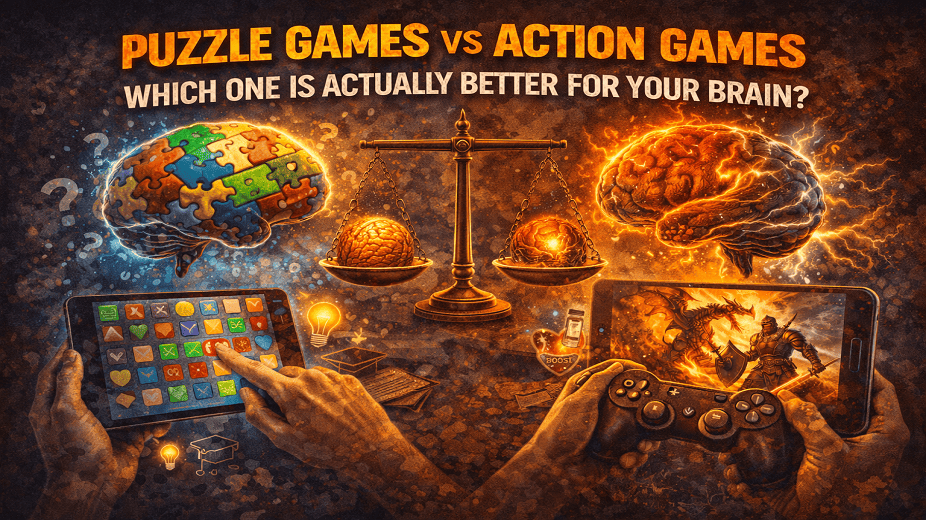
Puzzle Games vs Action Games: Which One Is Actually Better for Your Brain?
Ever catch yourself wondering why you feel sharper after crushing a level in Candy Crush, but somehow more wired after a session of Call of Duty? I’ve been there. One minute I’m calmly matching blocks on my phone during a boring wait, the next I’m yelling at the screen while dodging bullets in some shooter. Both are fun, but I always wondered—which one is actually doing something good for my brain?
Turns out, it’s not a simple “one wins” answer. Puzzle games and action games hit your brain in pretty different ways. And the science from the last few years (including some fresh 2025 studies) shows both can help, just not in the same areas. Here’s my take after digging into it and testing it on myself.
You know those moments when life feels scattered—too many tabs open in your head? That’s when I reach for a puzzle game. Sudoku, crosswords, Block Blast, or even a good old jigsaw. They force you to slow down, focus on patterns, and think things through without rushing.
Here’s the thing most people don’t realize: puzzle games seem to give a nice boost to things like working memory, attention to detail, and logical thinking. One study I came across found that folks playing puzzle-style games made fewer errors on certain cognitive tests compared to those grinding action or war games. It makes sense—you’re training your brain to hold information, spot connections, and stay patient.
I remember last year when I was stressed at work. I started doing a quick Sudoku every morning. Nothing dramatic, but after a couple weeks I felt like my mind wandered less during meetings. It wasn’t some miracle IQ boost, but it helped me feel more grounded. Older adults especially seem to get something out of this—crosswords and similar puzzles have shown small but real improvements in memory and daily functioning for people with mild cognitive issues.
The downside? The benefits can feel pretty specific. You get better at puzzles, sure, but it doesn’t always spill over into wildly better real-life multitasking or lightning-fast reactions. Some research even says the transfer to everyday smarts is limited. Still, for calm focus and that satisfying “aha” feeling, puzzles win for me on tired evenings.
Action games shine when it comes to reaction time, visual attention, spatial skills, and multitasking. Multiple studies (some going back years, others fresh in 2025) show that people who play them regularly are faster at processing information without losing accuracy. They switch between tasks better and spot things in their peripheral vision that non-gamers miss.
I tried this myself. After a week of short sessions in a shooter (nothing too violent, promise), my driving felt snappier—I reacted quicker to sudden lane changes. One 2025 study even found action game training led to changes in brain waves that suggested better neural efficiency, with effects sticking around after the training stopped.
There’s also evidence that action games can strengthen parts of the brain involved in attention and decision-making under pressure. In kids and young adults, heavier gaming (around 3+ hours a day in one big study) linked to slightly better performance on inhibition and working memory tasks, though with some trade-offs like higher attention problem reports.
But it’s not all upside. Some older research flagged potential shrinkage in the hippocampus (that’s your memory and navigation center) from heavy first-person shooter play, while 3D platformers or puzzle-platformers seemed to grow it instead. Newer stuff is more mixed and generally positive, especially for moderated play.
If I had to pick based on what the research says right now:
A 2025 CU Boulder study broke it down nicely: Action+ games (shooters, fighters, etc.) linked more to spatial reasoning strengths, while Puzzle+ games (including some sims) tied to better processing speed in certain tests. Another review showed action games often produce broader cognitive gains across perception, attention, and even some problem-solving.
Most people don’t realize the effects depend a lot on how much you play and what exactly you’re doing. Ten minutes of casual puzzle might perk you up without draining you. An hour of intense action could sharpen reflexes but leave you wired if you overdo it.
Real-life example: My friend who’s a teacher swears by quick puzzle apps during her lunch break—she says it helps her stay patient with kids all afternoon. Another buddy who games shooters competitively claims it improved his work focus during chaotic meetings. Both are probably right for their own brains.
Neither is “better” overall. Your brain isn’t a one-trick pony. Mixing them might be the real hack.
Try this: Use puzzles for calm focus sessions when you need clarity. Jump into action games when you want to train speed and adaptability. Keep sessions reasonable—studies showing benefits often used 30-60 minutes a few times a week, not all-day marathons.
And yeah, moderation matters. Too much of anything can backfire—action games might amp up stress hormones if you’re already anxious, while puzzles could feel repetitive if that’s all you do.
Other factors count too. Sleep, exercise, and real-world social stuff still matter more than any game. But as a fun supplement? Both puzzle and action games beat mindless scrolling.
If your goal is steady, thoughtful brain maintenance—puzzle games have a slight edge for many people, especially as we get older. If you want quicker reactions, better attention under fire, and multitasking practice—action games deliver more noticeable gains in those areas.
Personally? I rotate. A puzzle session to reset, an action burst when I need energy. My brain feels more balanced that way, and the science seems to back playing to your needs rather than picking sides.
What about you? Do you lean puzzle or action, and have you noticed any real difference in how your mind feels afterward? I’d love to hear—maybe I’ll try whatever you recommend next.
 Arcade
 Action
 Adventure
 Shooting
 Girl
Girl Puzzle
 Sport
Sport Horror
 Board
Board