
31/03/2026
Administrator
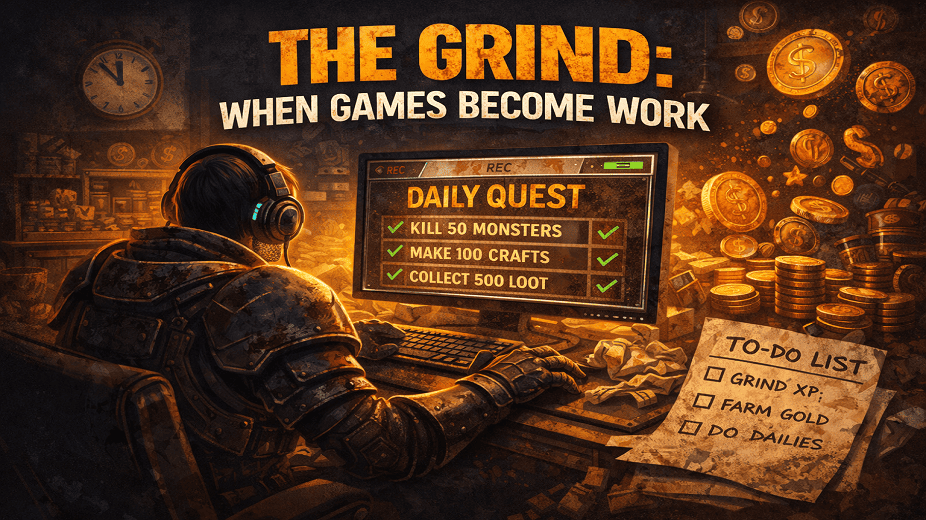
The Grind: When Games Become Work
I still remember the exact Tuesday night it happened. I’d just gotten home from a long day at the office, kicked off my shoes, and opened up the game I’d been pouring time into for months. Same login screen, same daily quests waiting, same materials I needed to farm for that next tiny upgrade. My shoulders were already tight from work, but I told myself “just 30 minutes.” Two hours later I was still there, doing the exact same repetitive loop, feeling more drained than when I started. No excitement, no “hell yeah” moments—just the quiet realization that this wasn’t play anymore. It was unpaid overtime in a virtual office I’d volunteered for.
That hit me hard. Gaming is supposed to be the thing you do to escape real work, not become another form of it. Yet here we are in 2026, and a ton of us are quietly burning out on the grind. Live-service games especially have turned what should be fun into a second job complete with checklists, timers, and that nagging feeling that you’re falling behind if you dare take a night off.
Here’s the thing most people don’t realize: the grind itself isn’t new, but the way modern games package it has gotten way more sophisticated and relentless. Old MMOs had plenty of repetitive farming, sure, but you usually knew what you were getting into. Today’s titles hide the chores behind shiny battle passes, seasonal events, and clever psychological hooks that keep you logging in even when your brain is screaming for a break. And it works—until it suddenly doesn’t, and you’re left wondering why something that used to bring joy now feels like another obligation.
It didn’t start with malice. Early games had grinding because that was the tech and design of the time. Leveling in classic RPGs, farming gold in old-school MMOs—it could feel meditative, even relaxing in a weird way. You were building something, watching your character grow, and the repetition had rhythm.
Then live-service models exploded. The promise was simple: constant new content, ongoing worlds, reasons to keep coming back. Publishers loved it because it meant steady revenue instead of one-and-done sales. Players loved the idea at first—endless updates, evolving stories, communities that stuck around.
But somewhere the balance tipped. Retention became king. Developers (or the executives pushing them) started designing systems around keeping players engaged as long as possible, not necessarily making every moment enjoyable. Daily logins, weekly resets, limited-time events that trigger FOMO, battle passes that dangle rewards just out of easy reach. The grind stopped serving the fun and started serving the metrics.
I fell for it hard with Destiny 2 back in the day. The loot chase was electric at first. That god-roll weapon dropping after a tough activity? Pure rush. But eventually the weekly ritual turned into a checklist I dreaded. I’d log in after dinner, knock out the same strikes and bounties, and feel more exhausted than refreshed. It stopped being “let’s see what cool stuff I get tonight” and became “I need to finish these so I don’t fall behind.” Sound familiar to anyone?
And 2025-2026 data shows I’m far from alone. Multiple high-profile live-service launches from 2025 saw player counts drop by 80-99% from their early peaks. Over half of the big ones lost more than 90% on Steam. Retention is the real killer now—getting players in the door is one thing, but keeping them month after month when the activities feel like chores is another. Even big names struggle with heavy churn, sometimes losing 40-60% of players within three months.
Games are masters at hijacking your brain’s reward system. Variable rewards—never quite knowing when the good drop or upgrade will come—trigger dopamine stronger than predictable ones. It’s the same principle behind slot machines. Add in FOMO from events that vanish if you miss them, social pressure from friends or guilds needing you for raids, and those little progress bars that give tiny hits of satisfaction, and suddenly you’re spending hours on autopilot doing stuff that stopped being fun ages ago.
The anticipation itself becomes addictive. Your brain releases dopamine not just when you get the reward, but when you’re chasing it. That “just one more run” feeling is powerful. Combine it with sunk-cost fallacy (“I’ve already put in 200 hours, can’t quit now”) and you’ve got a recipe for playing long after the joy has faded.
I’ve caught myself in that loop more times than I care to admit. Telling myself I’d farm for 30 minutes and looking up two hours later wondering where the evening went. It’s not a lack of willpower. It’s the game doing exactly what it was built to do—extend session time through smart behavioral design.
The darker side shows when it leads to real burnout. Emotional exhaustion from repetitive tasks, diminished sense of achievement even when you do progress, that detached feeling like you’re just going through the motions. Some players describe “gaming burnout” that mirrors work burnout—feeling drained by the very thing that’s supposed to recharge you. Studies have linked heavy grinding in certain games to lower psychological functioning, though moderate, enjoyable play doesn’t seem to hurt.
Most people don’t realize how gradual and sneaky the shift is. It starts exciting. You’re progressing, unlocking cool stuff, feeling powerful. Then upgrades get rarer, dailies pile up, and suddenly you’re doing repetitive chores in a virtual world just to keep your power level or not miss limited rewards. The game stops respecting your limited free time and starts demanding it like another job.
I’m not alone in this. A close friend poured months into a popular gacha-style game. He loved the characters and story early on. But endgame turned into nonstop resource farming for marginal stat boosts. He’d set alarms to do dailies before work, then grind more at night. One day he checked his total playtime—over 500 hours—and realized he hadn’t actually enjoyed a session in months. He quit cold turkey and described it as breaking up with a toxic partner. The relief was immediate.
Another buddy got deep into an MMO during the pandemic years. The social raiding with his guild kept him going at first—it felt like hanging out with friends. But as the game layered on more daily and weekly obligations, the raids started feeling like mandatory overtime. He’d log in stressed, worried about letting the team down if he missed a night. Guild drama on top of the grind eventually burned him out completely. He still misses the people sometimes, but not the second job the game had become.
Even single-player experiences can cross the line. Some massive open-world RPGs fill the map with collectibles and side quests that all blur together after a while. I tried one everyone was raving about last year. The world looked stunning, but after 60+ hours the side content started feeling like busywork. I pushed through because of sunk cost—“I’ve come this far”—and that’s exactly the trap games count on.
On the brighter side, some grinds still feel genuinely good. Games like Warframe or certain ARPGs manage to make farming satisfying because the loop stays engaging, the power fantasy ramps up nicely, or there’s enough variety and player agency. The difference is respect for your time. When the grind has clear purpose and doesn’t feel like it’s padding metrics, it can actually be relaxing or meditative. When it’s repetitive tasks designed mainly to keep you logging in or spending, it crosses into work territory fast.
Right now, a lot of players are openly exhausted. Discussions about live-service burnout are everywhere, with many 2025 titles seeing steep drop-offs because the grind started feeling more like obligation than entertainment. Seasonal resets, time-limited challenges, and heavy repetition made continued play feel like a chore list instead of a hobby.
Analysts point out that retention—not just big launches—is now the make-or-break factor. Even successful titles like Fortnite or Apex see significant churn, though their massive player bases help mask it somewhat. Newer releases without that established audience struggle more when the content feels engineered for spreadsheets rather than memorable moments.
Some developers are starting to notice. Talks about player wellbeing tools, fatigue detection, or better pacing have popped up. Games that prioritize actual fun over pure retention curves tend to keep players happier longer. But the pressure from publishers to hit engagement numbers and monetization targets remains strong. The result is more titles that feel built to keep you hooked rather than delighted.
I deleted three live-service games in the past six months. Each time it felt like lifting a weight off my shoulders. No more daily login anxiety. No more scanning patch notes like it was work email. My gaming time went back to being something I genuinely looked forward to instead of another box to check off.
Not all grinding is bad. Some games make repetition part of the charm—roguelikes where each run feels fresh, or cozy titles where farming is the relaxing point. The problem emerges when the grind stops serving enjoyment and starts serving retention or spending.
Red flags I’ve learned to watch for:
If several of those ring true, it might be time for an honest check-in. Games should add joy or relaxation to your life, not drain it like an unpaid second shift.
I still grind sometimes. There’s a certain satisfaction in mastering a loop or watching numbers go up when the game earns it. But I’m much pickier now. I set personal rules: no daily obligations that feel mandatory. If a game starts demanding more of my limited free time than I’m willing to give freely, I drop it without guilt or second-guessing.
Practical things that helped me regain control:
Life’s too short to treat your hobby like another job. There are thousands of great single-player experiences, thoughtful indies, and well-designed multiplayer games that don’t turn play into performance review season.
The industry won’t flip overnight. Live-service models still make money for some, and certain players genuinely enjoy long-term grinds when done right. But the visible fatigue in 2026—with steep player drops and growing conversations about burnout—shows more of us are voting with our time and wallets. We want games that respect us as humans with limited hours, not infinite retention metrics on a dashboard.
At the end of the day, gaming should feel like play. When it starts feeling like unpaid overtime with extra steps and FOMO timers, it’s perfectly okay to step back. You’re not quitting or being weak. You’re protecting something that’s supposed to bring you joy.
What about you? Have you ever had a game slowly turn into a grind that sucked the life out of it? Did you push through out of habit, make changes, or walk away completely? Or maybe you still love a good honest grind when the game gets the balance right—tell me about those too. Drop your stories or thoughts below. These conversations matter more than the loud “just grind harder” takes ever will.
Sometimes the healthiest thing a game can teach you is when it’s time to log off without guilt.
 Arcade
 Action
 Adventure
 Shooting
 Girl
Girl Puzzle
 Sport
Sport Horror
 Board
Board