
05/04/2026
Administrator
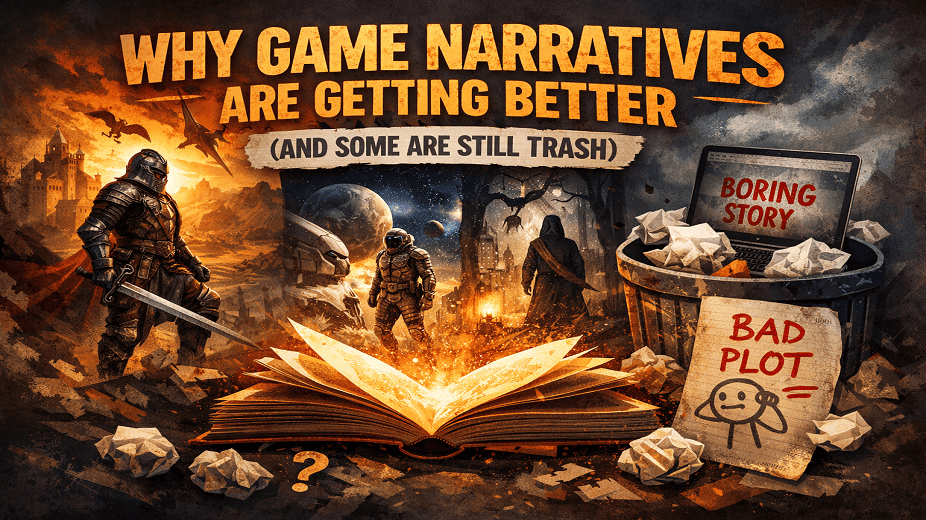
Why Game Narratives Are Getting Better (And Some Are Still Trash)
I’ll never forget closing The Last of Us Part II years ago and just sitting there in the dark, controller still in my hands, feeling completely drained in the best possible way. Not because of some epic boss fight or explosion, but because the story had twisted the knife so deep into Ellie and Abby’s lives that I needed a minute to breathe. Then, barely a month later, I jumped into another big-budget game everyone was hyping as the “next big thing.” Gorgeous world, buttery-smooth gameplay… and a story so paint-by-numbers I started skipping cutscenes by hour eight. Heroes spouting generic tough-guy lines, villains explaining their evil plan like bad Bond villains, zero emotional stakes. Same old slop, just with shinier graphics.
Here’s the thing most people don’t realize: better game narratives aren’t just about throwing more money at fancy motion capture or hiring Hollywood writers. They’re about studios finally treating story as something that matters as much as combat or exploration instead of slapping it on as an afterthought. We’re seeing real progress, especially in the last couple years, but the lows are still embarrassingly low because old habits, corporate caution, and rushed development die hard.
A decade ago, a lot of big games treated story like marketing fluff. You got a serviceable plot that existed mainly to give you reasons to shoot things or collect shiny objects. Dialogue was functional at best, characters felt like archetypes, and choices rarely mattered beyond a couple flavor text changes.
Now? More studios are bringing writers in early, giving them actual say in design, and letting narrative influence mechanics instead of the other way around. That shift is huge.
Take Clair Obscur: Expedition 33, which dropped in 2025 and still gets talked about constantly. It’s a turn-based RPG with Belle Époque vibes, but the combat rhythm ties directly into the story’s themes of time, loss, and inevitability. The characters carry real grief and weight — not just “sad backstory for motivation” filler. One late-game moment involving a companion’s past had me pause the game and just sit with it. That kind of emotional payoff used to be rare outside a handful of studios. Now it’s showing up more often.
Death Stranding 2: On the Beach doubled down on Kojima’s signature brand of weird, heartfelt absurdity with better pacing and characters who actually feel like they’re changing. Ghost of Yōtei sharpened its predecessor’s edge by giving its lead a more tragic, grounded arc that didn’t feel like token representation. Even mid-tier stuff like Metaphor: ReFantazio blends political intrigue, personal growth, and fantasy in ways that feel fresh instead of recycled.
Indies have been carrying the torch for years. Disco Elysium showed you could make a game that’s basically an interactive novel with incredible depth and humor. Hades and its sequel turned Greek myths into something personal, funny, and heartbreaking through sharp writing and evolving relationships. Smaller teams often take bigger risks because they don’t have ten layers of executives watering everything down.
Performance capture has improved massively too. When actors deliver lines in games like the Last of Us series or recent God of War entries, it doesn’t feel like they’re reading in a booth anymore. Facial animations, body language, the way voices crack or tremble — it all sells the emotion. We’re mostly past the uncanny valley, and that makes stories land harder.
A few things are driving this.
The audience has grown up. Gamers aren’t just teenagers anymore. More women, more adults in their 30s and 40s, more people who read books and watch prestige TV. Players call out lazy tropes and flat characters louder than ever, and studios notice when reviews or sales reflect that.
Tech helps without being the whole story. Better tools for branching dialogue, dynamic systems, and even some careful AI assistance for generating variations mean writers can do more ambitious things without the project exploding in scope. But the best stuff still comes from human writers guiding it — AI can help with volume, but it needs heavy editing to avoid sounding generic.
Single-player narrative games are having a quiet comeback after years of live-service dominance. Players are craving stories with actual endings again. Devs are responding with more focused experiences that don’t need endless content loops to justify their existence. Titles blending episodic storytelling with meaningful choices or rhythmic combat that reinforces themes show the medium evolving in cool ways.
I finished Red Dead Redemption 2 years ago and thought, “this feels as good as any Western novel.” The slow burn, the moral weight, the way the world reacted to your choices — it felt literary. We’re seeing more of that ambition now, not just in AAA but in mid-sized and indie projects too.
Player expectations have shifted. People want characters who feel like real people with histories, flaws, and actual growth. Moral gray areas. Consequences that sting. When a game nails that — the complicated relationships in The Last of Us series, the ensemble in Baldur’s Gate 3 — it stays with you long after you put the controller down.
For every leap forward, there’s still plenty of garbage floating around. You know the type: cutscenes that feel like bad soap operas, dialogue that sounds like it was written by a committee in a marketing meeting, villains who monologue about “true power” while the hero stares stoically. Games that prioritize spectacle over substance, or worse, treat story as something you can safely skip.
2025 had its share of duds. MindsEye got slammed not just for technical mess but for incoherent plotting and dull characters. Some licensed tie-ins and quick cash-grabs still ship with writing that feels phoned in. Even big franchises occasionally phone it in with generic side quests, forgettable NPCs, or plots that resolve with a big explosion instead of any real emotional payoff.
I tried one hyped open-world game last year after all the trailers made it look deep. The world looked stunning, but the story? Flat as a pancake. Main character had the personality of wet cardboard. Supporting cast spouted clichés. Twists you could see coming from the first hour. I pushed through because the gameplay loop was decent, but I felt nothing by the end. That’s the most frustrating kind — when the budget is clearly there for graphics and systems, but the writing gets treated like an afterthought.
Some games still suffer from “tell, don’t show” syndrome. Walls of exposition instead of letting actions and quiet moments build the world. Others have branching choices that feel meaningless because everything converges to the same ending anyway. And don’t get me started on games that try to be “edgy” or “mature” with shock value but have nothing thoughtful to say underneath.
The worst are the ones that hype depth in trailers and then deliver the same hero’s journey template we’ve seen a thousand times, with characters who exist only to deliver lore or die for motivation.
The narratives that actually work invest in characters first. You care what happens to them because they feel like people, not plot devices. Disco Elysium lets you role-play a broken detective in ways that are hilarious, tragic, and profound. The writing respects your intelligence and rewards paying attention.
Pacing is crucial. Good stories know when to breathe with quiet moments and when to crank the tension. Bad ones either drag with filler or rush through emotional beats so fast you don’t feel them.
Integration with gameplay makes or breaks it. When story and mechanics support each other, it’s magic. Combat that reflects character growth, exploration that reveals backstory naturally, choices that genuinely change how the world treats you. When they clash — beautiful cutscenes followed by boring fetch quests — the whole illusion falls apart.
Diversity in writing voices helps too. More studios bringing in people from different backgrounds leads to fresher perspectives and fewer tired tropes. Not every attempt lands perfectly, but the effort shows in games that feel less cookie-cutter.
2026 looks promising for story fans. Clair Obscur: Expedition 33 building on its strong 2025 reception, Death Stranding 2, potential new entries in beloved series, and a bunch of indies pushing boundaries. We’re seeing more experiments with episodic formats, smarter branching, and stories that blend genres in unexpected ways.
But the trash won’t disappear. Budget doesn’t guarantee quality, and some publishers will always chase safe trends over substance. The hope is that as players vote with their time — finishing and praising the strong ones, dropping the weak ones early — more studios will prioritize good writing.
I’ve quit more games midway because the story bored me than because the gameplay sucked. And I’ve replayed others purely for the narrative. That’s the power good game stories have now: they can stand alongside books or films while still being interactive in ways nothing else can match.
At the end of the day, when a game nails its story, it stops feeling like “just a game.” It becomes a world you lived in, characters you miss when it’s over, choices you still think about months later. We’re getting more of those experiences, and that’s worth celebrating — even when the duds still slip through and remind us how far we still have to go.
What about you? What’s a game whose story absolutely wrecked you (in the best way)? Or one that had you rolling your eyes the whole time despite solid gameplay? Drop your favorites and your biggest disappointments below. I’m always hunting for the next one that’ll keep me up too late because I can’t stop clicking through dialogue.
Sometimes the best part of gaming isn’t the shooting, the jumping, or the loot. It’s those quiet moments when the story makes you feel something real.
 Arcade
 Action
 Adventure
 Shooting
 Girl
Girl Puzzle
 Sport
Sport Horror
 Board
Board