

16/03/2026
Administrator
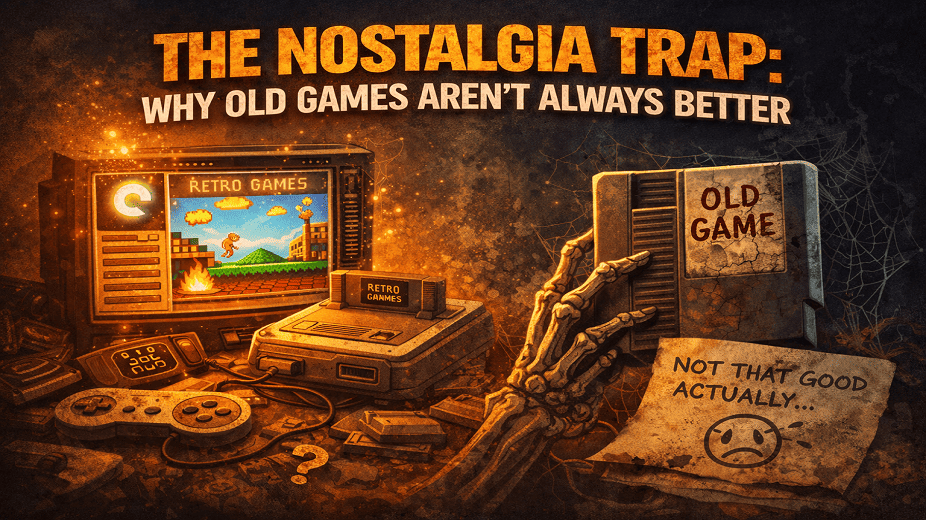
The Nostalgia Trap: Why Old Games Aren't Always Better
I caught myself doing it again last month. I was scrolling through old screenshots on my phone, saw a blurry pic from Ocarina of Time on the N64, and suddenly felt this warm wave of "man, games were just better back then." No loading screens that took forever, no battle passes, no live-service nonsense. Just pure adventure. I almost fired up the emulator right then.
But I stopped. Because I've been burned before. I actually booted up a couple of my childhood favorites a few years ago during a slow weekend, expecting magic. What I got instead was frustration, clunky controls, and that sinking feeling of "wait... was it always this bad?" The nostalgia trap had me good. And I'm willing to bet it's got a lot of us.
Here's the thing most people don't realize: nostalgia isn't just fond memories. It's a sneaky cognitive bias that paints the past in soft, golden light while conveniently forgetting the rough edges. Psychologists call it rosy retrospection or the fading affect bias — we remember the good stuff way stronger and let the annoying parts fade. In gaming, that means we glorify the hits from our childhood and conveniently blank on all the terrible movie tie-ins, broken releases, and hours spent staring at a "please insert disk 2" screen.
In 2026, with remakes everywhere and endless "old games were peak" discourse online, it's worth unpacking this. Not to shit on classics — some genuinely hold up beautifully — but to admit that not everything from the "good old days" was gold. Sometimes the new stuff is straight-up better, and pretending otherwise keeps us stuck in the past.
Let me tell you about the time I tried replaying GoldenEye 007 on an N64 emulator. In my head, it was the pinnacle of multiplayer shooters. Me and my cousins huddled around the TV, screaming at each other, perfect splitscreen chaos. Pure joy.
Reality? The controls felt awful after years of modern aiming. The graphics were muddy even with filters. Levels that seemed huge as a kid felt tiny and repetitive. I stuck with it for an hour, mostly out of stubbornness, then switched to something modern and felt immediate relief. The fundamentals were still there — solid level design, tense sneaking — but the execution hadn't aged gracefully for me.
This happens all the time. Survivorship bias plays a huge role. We only remember the standout games from each era because the mediocre or outright bad ones got traded in, forgotten, or never finished. Back in the 90s and early 2000s, there were tons of rushed licensed games, buggy messes, and experiments that flopped hard. We just don't talk about them as much as Super Mario World or Half-Life.
I rented so many duds as a kid. That one Superman game on N64? Nightmare fuel with its terrible flying controls and empty world. Or those awful movie tie-ins that barely functioned. My brain conveniently edited those out and kept the highlights reel. Most people don't realize how much memory filters this stuff. We associate old games with simpler times — no work stress, school was easier (or at least we remember it that way), friends were always around to play splitscreen. The game itself gets credit for feelings that had more to do with our lives back then.
One big reason old games can disappoint on replay? They've been outgrown by modern standards in ways that feel jarring.
Take camera controls. Early 3D games often had fixed or tanky cameras that made navigation a chore. Resident Evil on PlayStation had those iconic tank controls that felt tense and scary at the time. Replay it now and it can feel like fighting the game itself. Modern survival horror lets you move freely while still building dread through better pacing and atmosphere.
Or inventory management. Some classic RPGs made you juggle items like a puzzle, with limited slots and no quick sorting. It was "realistic" or whatever, but mostly tedious. Today's games streamline that without losing the fun of collecting and building.
Graphics are the obvious one, but it's deeper than pixels looking blocky. Old games on modern high-res screens can look worse — aliasing, low draw distances, pop-in that wasn't as noticeable on CRT TVs. Sound design too. Chiptune music hits different when you're nostalgic, but some early voice acting or effects sound tinny and dated now.
I tried Final Fantasy VI again recently because everyone swears by it. The story and characters still slap — that opera scene? Timeless. But the random encounters every five steps, the slow pace of some dungeons, the grind... it tested my patience more than I expected. Younger me had all the time in the world and no comparison. Now I catch myself thinking "this could use some quality-of-life tweaks that modern remakes sometimes add."
Not every old game suffers this way. Some like Chrono Trigger or The Legend of Zelda: A Link to the Past still feel fresh because their core design was rock solid. But many don't. And pretending they all do is where the trap snaps shut.
Online, especially in certain corners of Reddit or YouTube, you'll see endless rants about how modern games suck because of microtransactions, always-online requirements, or bloated open worlds. And yeah, some of that criticism is fair. Live-service titles that feel like Skinner boxes or games that launch half-finished can be exhausting.
But let's be honest — the past had its share of monetization nightmares too. Arcade games were literally designed to eat your quarters. Some console games had awful difficulty spikes or required buying strategy guides because they were opaque as hell. DLC existed in spirit with expansion packs that sometimes felt mandatory.
The big difference? We have more choice now. If a modern game annoys you with MTX, you can skip it and play something else — there are thousands of great single-player experiences, indies, and even modern retro-style games that capture the spirit without the old frustrations.
Most people don't realize that part of the "old games were better" feeling comes from life stage. When you're a kid or teen with fewer responsibilities, every gaming session feels epic. As an adult with a job, bills, and maybe kids, even a great game can feel like "just another thing on the list." The nostalgia mixes with longing for simpler times, and the game becomes a symbol for that.
One study-ish thing that stuck with me from reading around: people in sensory deprivation tanks recalled way more positive memories than negative. Our brains are wired to emphasize the good for mental health. In gaming, that means we downplay the rage-quits from unfair difficulty or the boredom of backtracking without fast travel.
Let's flip it and talk about where new games win without the rose tint.
Quality of life features are huge. Auto-saves, better tutorials that don't insult your intelligence, accessibility options — these make games more welcoming without dumbing them down. Old games could be brutally punishing, sometimes unfairly so. Modern ones often let you adjust difficulty or add assists while keeping the core challenge.
Open worlds? Yeah, some are bloated. But when done right — think Breath of the Wild or Elden Ring — they give freedom that linear old-school games couldn't dream of. Exploration feels rewarding because of smart design, not because you have a checklist.
Multiplayer has its issues with toxicity and monetization, but the good stuff — seamless co-op, better netcode, cross-play — connects people easier than dialing into a BBS or hoping your modem didn't drop.
I recently played a newer indie that scratched the same itch as old adventure games but with smoother controls and no dead ends that require a guide. It felt respectful to the past while fixing the pain points. That's the sweet spot a lot of "modern retro" games hit, like Hollow Knight or Celeste. They take the spirit — tight platforming, exploration, challenge — and polish it for today.
Some old games have aged like fine wine because their design was timeless. Others... not so much. Early 3D experiments often look and control rough now. Tank controls, fixed cameras, low-poly models that clip everywhere. We forgave it then because it was new and exciting. Now we have higher standards.
The nostalgia trap isn't harmless. It can make us unfairly harsh on new releases. Every big game gets compared to some idealized memory of a classic, and when it doesn't perfectly match, it's "soulless" or "woke" or whatever the current complaint is. That kills open-mindedness.
It also stops some people from trying new things. I've got friends who stick almost exclusively to remasters or emulated old stuff, missing out on fresh experiences that could become their new favorites. Gaming evolves. Mechanics improve, stories get bolder, tech opens new possibilities. Clinging too hard to the past means missing the present.
On the flip side, some nostalgia is beautiful and worth chasing. Replaying a game that genuinely holds up can be magical. Remakes that fix issues while keeping the soul — like the Resident Evil remakes — prove you can honor the past without pretending it was flawless.
The key is balance. Appreciate the old games for what they were and the memories they gave, but don't let that blind you to progress. Some old titles still slap harder than anything new in their genre. Others feel like historical artifacts — interesting to visit once, but not something you'd main today.
If you're feeling stuck in nostalgia, try this: Pick an old favorite and replay it honestly. No rose glasses. Note what still works and what frustrates you now. Then play something modern that tries similar things. Compare without bias.
Or mix it up. Play a "modern retro" game that captures the vibe but with today's polish. Or dive into genres you skipped as a kid.
For me, I've started being more intentional. I'll fire up a classic for a short session, enjoy the memories, then switch to something current. It keeps the good feelings without the disappointment of forcing a full replay that doesn't land the same.
At the end of the day, games are better than ever in variety and accessibility. The library is massive. Some old gems are timeless. Many aren't. The trap is thinking the past was a golden age with no duds and the present is all downhill.
It wasn't. And it isn't.
What about you? Got an old game you replayed and thought "hmm, maybe not as good as I remembered"? Or one that still holds up perfectly? Or a modern game that scratched the same itch better? Tell me — I'm always curious how other people navigate this nostalgia stuff. Sometimes the best part is realizing we're all a little biased, and that's okay as long as we own it.
 Arcade
 Action
 Adventure
 Shooting
 Girl
Girl Puzzle
 Sport
Sport Horror
 Board
Board